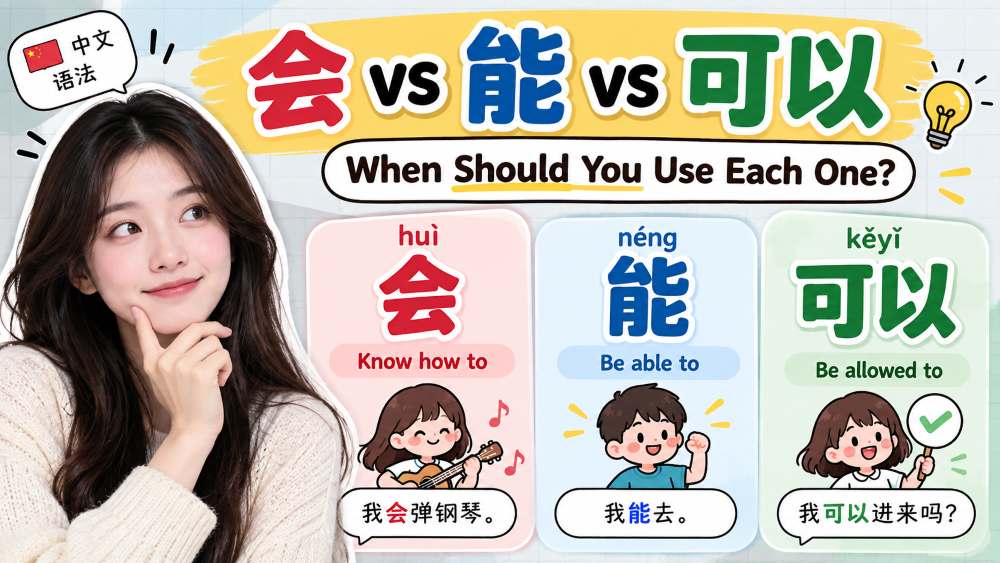
In Mandarin Chinese, 会 (huì), 能 (néng), and 可以 (kěyǐ) can all mean “can” or “be able to.” However, they are not completely interchangeable. Someone might know how to swim but be unable to swim because of an injury. Similarly, a person might know how to drive but not be allowed to drive because they do not have a driver’s license.
These situations illustrate the differences between the three words. To use them correctly, Chinese learners need to understand whether they are talking about a learned skill, an ability, practical circumstances, or permission.
1. What Is the Difference Between 会, 能, and 可以?
Let’s start with a comparison table:
| Feature | 会 (huì) | 能 (néng) | 可以 (kěyǐ) |
|---|---|---|---|
| Common meanings | Know how to, can, will | Can, be able to | Can, may, be allowed to |
| Main focus | Learned skills; predictions | Ability and practical circumstances | Permission and feasibility |
| Typical situations | Knowing how to swim or drive | Having enough strength, time, or suitable conditions | Asking permission, granting permission, suggesting options |
| Negative form | 不会 | 不能 | 不可以 |
| Other uses | Predicting future events | Can also express permission | Can also express practical possibility |
These are useful starting points, but all three words have broader uses, especially 能 and 可以.
会 (huì): Knowing How to Do Something
会 is commonly used to describe a skill acquired through learning, practice, or experience. This includes swimming, driving, speaking a foreign language, or playing a musical instrument.
Examples:
我会游泳。 / Wǒ huì yóuyǒng. / I know how to swim.
她会弹钢琴。 / Tā huì tán gāngqín. / She can play the piano.
我会说一点儿中文。 / Wǒ huì shuō yìdiǎnr Zhōngwén. / I can speak a little Chinese.
In these sentences, 会 indicates that the subject has learned the skill. However, it does not necessarily mean the person can perform the activity under all circumstances.
For example:
我会游泳,但是今天不能游泳。 / Wǒ huì yóuyǒng, dànshì jīntiān bù néng yóuyǒng. / I know how to swim, but I can’t swim today.
The speaker still knows how to swim. What has changed is the situation preventing them from swimming.
Besides learned skills, 会 can also express predictions about future events.
明天会下雨。 / Míngtiān huì xiàyǔ. / It will probably rain tomorrow.
Here, 会 does not mean “know how to.” Instead, it expresses a prediction about the weather.
能 (néng): Having the Ability or Conditions to Do Something
能 is commonly used when talking about whether someone can perform an action because of their physical ability, available time, health, or practical circumstances.
Examples:
我今天能去。 / Wǒ jīntiān néng qù. / I can go today.
他受伤了,不能跑步。 / Tā shòushāng le, bù néng pǎobù. / He is injured, so he can’t run.
我现在不能接电话。 / Wǒ xiànzài bù néng jiē diànhuà. / I can’t answer the phone right now.
In these examples, 能 does not necessarily describe a learned skill. Instead, it indicates whether the person has the ability or suitable conditions to perform the action.
For example, 我现在不能接电话 does not mean the speaker does not know how to use a phone. They might be in a meeting, driving, or busy with something else.
Depending on the context, 能 can also appear in questions asking for permission.
可以 (kěyǐ): Being Allowed to Do Something or Having an Available Option
可以 is commonly used to ask for permission, grant permission, or indicate that an action is acceptable.
Examples:
我可以进来吗? / Wǒ kěyǐ jìnlái ma? / May I come in?
你可以坐这里。 / Nǐ kěyǐ zuò zhèlǐ. / You can sit here.
这里不可以抽烟。 / Zhèlǐ bù kěyǐ chōuyān. / Smoking is not allowed here.
In these sentences, 可以 relates to whether an action is permitted or acceptable.
However, 可以 is not limited to permission. It can also describe a feasible option or suggest a possible course of action.
For example:
我们可以坐地铁去。 / Wǒmen kěyǐ zuò dìtiě qù. / We can take the subway.
Here, 可以 presents taking the subway as a possible option. It does not necessarily involve asking anyone for permission.
2. When Can 会, 能, and 可以 Be Used Interchangeably?
To understand the differences, it helps to compare the three words in the same situation.
Case 1: Knowing How to Do Something vs. Being Able to Do It
Consider three sentences using 游泳 (to swim):
| Chinese sentence | English meaning | Main emphasis |
|---|---|---|
| 我会游泳。 | I know how to swim. | The speaker has learned the skill |
| 我能游泳。 | I can swim. | The speaker has the ability or suitable conditions to swim |
| 我可以游泳。 | I can swim / I’m allowed to swim. | Swimming is permitted or possible in the context |
For example, someone who knows how to swim but is currently injured might say:
我会游泳,但是现在不能游泳。 / Wǒ huì yóuyǒng, dànshì xiànzài bù néng yóuyǒng. / I know how to swim, but I can’t swim right now.
If a doctor later allows the person to return to swimming, they might say:
医生说我现在可以游泳了。 / Yīshēng shuō wǒ xiànzài kěyǐ yóuyǒng le. / The doctor said I can swim again now.
In other words, 会 focuses on the learned skill, 能 on the ability to perform the action under particular circumstances, and 可以 on permission or feasibility.
Case 2: 能 vs 可以 When Asking for Permission
In everyday conversation, both 能 and 可以 can be used in questions requesting permission.
| Chinese sentence | English meaning | Nuance |
|---|---|---|
| 我能进去吗? | Can I go inside? | May ask about ability or permission |
| 我可以进去吗? | May I go inside? | More directly expresses a request for permission |
| 我会进去吗? | Will I go inside? | Not a normal way to ask permission |
If you are standing outside a room and want permission to enter, 我可以进去吗? is a clear choice.
However, 我能进去吗? can also function as a request for permission in the right context. Therefore, it would be incorrect to say that 能 can never be used to ask permission.
By contrast, 会 does not normally express permission. In a question such as 我会进去吗?, it relates to whether the action is expected to happen rather than whether someone allows it.
Case 3: Using All Three Words with the Same Verb
Now consider the verb 开车 (to drive).
| Chinese sentence | English meaning | Main emphasis |
|---|---|---|
| 我会开车。 | I know how to drive. | Driving skill |
| 我能开车。 | I can drive. | Ability or circumstances |
| 我可以开车。 | I can drive / I’m allowed to drive. | Permission or feasibility |
Suppose someone knows how to drive but has consumed alcohol. They might say:
我会开车,但是今天不能开车。 / Wǒ huì kāichē, dànshì jīntiān bù néng kāichē. / I know how to drive, but I can’t drive today.
Someone who knows how to drive but does not yet have a driver’s license might say:
我会开车,但是还没有驾照,所以不能开车。 / Wǒ huì kāichē, dànshì hái méiyǒu jiàzhào, suǒyǐ bù néng kāichē. / I know how to drive, but I don’t have a driver’s license yet, so I’m not allowed to drive.
This example also shows that 不能 can express restrictions imposed by rules, not just a lack of ability.
Case 4: Comparing the Negative Forms
| Negative form | Common meaning | Example |
|---|---|---|
| 不会 | Don’t know how to; predicted not to happen | 我不会游泳。 |
| 不能 | Cannot; must not | 我今天不能游泳。 |
| 不可以 | Not allowed; unacceptable | 这里不可以游泳。 |
Examples:
我不会游泳。 / Wǒ bú huì yóuyǒng. / I don’t know how to swim.
我今天不能游泳。 / Wǒ jīntiān bù néng yóuyǒng. / I can’t swim today.
这里不可以游泳。 / Zhèlǐ bù kěyǐ yóuyǒng. / Swimming is not allowed here.
These three sentences may all involve the English word “can’t,” but their meanings are different. The first describes a lack of skill, the second a limitation on performing the activity, and the third a restriction on permission.
Note that 不能 can also express prohibition, especially in rules such as 这里不能停车 (Parking is not allowed here). Therefore, 不能 and 不可以 sometimes overlap.
3. Common Mistakes When Using 会, 能, and 可以
Mistake 1: Using 会 to Ask for Permission
Because 会 can sometimes be translated as “can,” learners may mistakenly use it when asking whether they are allowed to do something.
| Unsuitable for the intended meaning | Better choice | Explanation |
|---|---|---|
| 我会进来吗? | 我可以进来吗? | Asking permission to enter a room |
| 我会坐这里吗? | 我可以坐这里吗? | Asking whether sitting here is allowed |
会 does not directly express permission. Therefore, 可以 is usually the more appropriate choice when asking for permission.
Mistake 2: Confusing 不会 with 不能
Not knowing how to do something is different from being unable to do it under certain circumstances.
| Intended meaning | Appropriate sentence | Explanation |
|---|---|---|
| I don’t know how to drive | 我不会开车。 | The speaker lacks driving skills |
| I can’t drive today | 我今天不能开车。 | Circumstances prevent driving |
| I don’t know how to speak Chinese | 我不会说中文。 | The speaker lacks the language skill |
| I can’t talk right now | 我现在不能说话。 | The current situation prevents speaking |
For example:
我不会开车。 / Wǒ bú huì kāichē. / I don’t know how to drive.
我今天不能开车。 / Wǒ jīntiān bù néng kāichē. / I can’t drive today.
If you know how to drive but cannot drive today, using 不会 would not express your intended meaning.
Mistake 3: Assuming 不能 Only Expresses Inability and 不可以 Only Expresses Permission
In practice, both expressions can indicate that something is prohibited.
Examples:
这里不能停车。 / Zhèlǐ bù néng tíngchē. / Parking is not allowed here.
这里不可以停车。 / Zhèlǐ bù kěyǐ tíngchē. / Parking is not allowed here.
Both sentences can express a rule prohibiting parking.
Therefore, the rule “不能 = inability, 不可以 = lack of permission” is only a starting point and does not cover every situation.
Mistake 4: Thinking 会 Only Describes Learned Skills
会 can also express predictions about future events.
Examples:
明天会下雨。 / Míngtiān huì xiàyǔ. / It will probably rain tomorrow.
他会来的。 / Tā huì lái de. / He will come.
In these sentences, 会 does not describe a learned skill. It expresses a prediction or expectation.
Similarly, 不会 can be used to make negative predictions.
他不会来的。 / Tā bú huì lái de. / He won’t come.
Therefore, when you encounter 会 or 不会, pay attention to the verb and context to determine whether the sentence describes a skill or a prediction.
4. Practice: Should You Use 会, 能, or 可以?
Fill in each blank with the appropriate word. Some sentences may have more than one correct answer depending on the context.
Exercise 1: 我___说中文。 / Wǒ ___ shuō Zhōngwén. / I know how to speak Chinese.
Exercise 2: 我今天生病了,不___去上班。 / Wǒ jīntiān shēngbìng le, bù ___ qù shàngbān. / I’m sick today, so I can’t go to work.
Exercise 3: 老师,我___进来吗? / Lǎoshī, wǒ ___ jìnlái ma? / Teacher, may I come in?
Exercise 4: 明天___下雨。 / Míngtiān ___ xiàyǔ. / It will probably rain tomorrow.
Exercise 5: 他___弹钢琴。 / Tā ___ tán gāngqín. / He knows how to play the piano.
Exercise 6: 这里不___抽烟。 / Zhèlǐ bù ___ chōuyān. / Smoking is not allowed here.
Exercise 7: 我们___坐地铁去。 / Wǒmen ___ zuò dìtiě qù. / We can take the subway.
Exercise 8: 我现在有时间,___帮你。 / Wǒ xiànzài yǒu shíjiān, ___ bāng nǐ. / I have time now, so I can help you.
Answers and Explanations
| Exercise | Answer | Explanation |
|---|---|---|
| 1 | 会 | Describes a learned language skill |
| 2 | 能 | The speaker cannot go to work because of illness |
| 3 | 可以 | A clear and common way to request permission |
| 4 | 会 | Predicts the weather |
| 5 | 会 | Describes a learned musical skill |
| 6 | 能 / 可以 | Both can express prohibition |
| 7 | 可以 / 能 | Both can describe a feasible option, depending on context |
| 8 | 能 / 可以 | Both can express the ability to help under current circumstances |
In Exercise 3, 能 can also be used to request permission in conversation. Similarly, in Exercises 7 and 8, the choice depends on whether the speaker emphasizes practical circumstances or the feasibility of the action.
会, 能, and 可以 can all mean “can,” but each has its own common uses. 会 often describes learned skills or predictions, 能 focuses on ability and practical circumstances, while 可以 commonly expresses permission or a feasible option.
When you’re unsure which word to choose, ask yourself three questions: Am I talking about knowing how to do something? Having the ability or conditions to do it? Or being allowed to do it?
These questions are useful starting points, not absolute rules. In real Chinese conversations, especially with 能 and 可以, their meanings can overlap. Understanding the context and practicing with complete sentences will help you choose the right word more accurately and naturally.