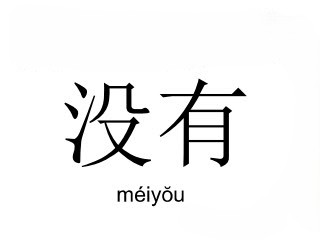
When learning negation in Chinese, 不 (bù) and 没(有) (méi(yǒu)) are two words that are very easy to confuse. Both can be translated as “not,” but they are not always interchangeable. One especially important case is when you want to say that an action did not happen in the past. In this situation, Chinese usually uses 没 or 没有 before the verb, rather than 不.
| Situation | Structure | Example | Remember |
|---|---|---|---|
| An action did not happen in the past | 没(有) + Verb | 我昨天没去学校。 (Wǒ zuótiān méi qù xuéxiào.) – I didn’t go to school yesterday. | Use 没 / 没有 before the verb. |
| Changing a past affirmative sentence into a negative one | Verb + 了 → 没(有) + Verb | 我昨天看了电影。 → 我昨天没看电影。 (Wǒ zuótiān méi kàn diànyǐng.) – I didn’t watch a movie yesterday. | When negating with 没(有), 了 is dropped. |
| Talking about an experience that has never happened | 没(有) + Verb + 过 | 我没去过北京。 (Wǒ méi qùguo Běijīng.) – I have never been to Beijing. | With experience, 过 stays in the sentence. |
1. To say “didn’t do something,” use 没(有) + verb
The basic structure is quite simple:
Subject + 没(有) + Verb + Object
For example:
我没有去学校。 (Wǒ méiyǒu qù xuéxiào.) – I didn’t go to school.
他没吃早饭。 (Tā méi chī zǎofàn.) – He didn’t eat breakfast.
昨天我没有上课。 (Zuótiān wǒ méiyǒu shàngkè.) – I didn’t have class yesterday.
她没买那条裙子。 (Tā méi mǎi nà tiáo qúnzi.) – She didn’t buy that skirt.
我昨天没看电影。 (Wǒ zuótiān méi kàn diànyǐng.) – I didn’t watch a movie yesterday.
他们上个月没有去北京。 (Tāmen shàng ge yuè méiyǒu qù Běijīng.) – They didn’t go to Beijing last month.
In conversation, both 没 and 没有 can be used. 没 is shorter and appears very often in spoken Chinese.
For example:
我没吃。 (Wǒ méi chī.) – I didn’t eat.
我没有吃。 (Wǒ méiyǒu chī.) – I didn’t eat.
Both sentences are basically fine. The only difference is that the second one uses the full form 没有.
Another thing to keep in mind is that 没(有) itself is not a “past tense marker” in the same way English changes verb forms. Context and time words usually help make it clear when the action happened.
For example:
昨天我没喝咖啡。 (Zuótiān wǒ méi hē kāfēi.) – I didn’t drink coffee yesterday.
上个星期我没上班。 (Shàng ge xīngqī wǒ méi shàngbān.) – I didn’t work last week.
去年我没有回家。 (Qùnián wǒ méiyǒu huí jiā.) – I didn’t go home last year.
But a simple sentence like:
我还没吃饭。 (Wǒ hái méi chīfàn.) – I haven’t eaten yet.
means that the action has not happened yet up to the present moment.
So it is better to understand 没(有) as showing that an action did not happen or has not happened yet, rather than treating it as a direct equivalent of an English past tense.
2. When negating with 没(有), remember to drop 了
This is a very common place to make mistakes. The key point is that when 了 is used to show that an action was completed, and you negate that action with 没(有), 了 is usually dropped.
Suppose the affirmative sentence is:
我去了学校。 (Wǒ qù le xuéxiào.) – I went to school.
When you want to say that the action did not happen, you do not say:
我没有去了学校。 ❌
Instead, you say:
我没有去学校。 (Wǒ méiyǒu qù xuéxiào.) – I didn’t go to school.
Similarly:
他买了那本书。 (Tā mǎi le nà běn shū.) – He bought that book.
In the negative:
他没买那本书。 (Tā méi mǎi nà běn shū.) – He didn’t buy that book.
Another example:
妹妹买了那条裙子。 (Mèimei mǎi le nà tiáo qúnzi.) – My younger sister bought that skirt.
→
妹妹没买那条裙子。 (Mèimei méi mǎi nà tiáo qúnzi.) – My younger sister didn’t buy that skirt.
Or:
我昨天看了这部电影。 (Wǒ zuótiān kàn le zhè bù diànyǐng.) – I watched this movie yesterday.
→
我昨天没看这部电影。 (Wǒ zuótiān méi kàn zhè bù diànyǐng.) – I didn’t watch this movie yesterday.
A simple way to remember it is:
Verb + 了 → the action happened / was completed.
没(有) + Verb → the action did not happen.
So with simple past-action sentences, do not try to keep both 没有 and 了 just because the original affirmative sentence had 了.
However, you should not turn this into an absolute rule that “if there is 没, there can never be 了,” because 了 has other uses as well, especially when it appears at the end of a sentence. For this article, it is enough to remember the rule above when you are negating a completed action.
3. Don’t confuse 没(有) with 不, and remember the case with 过
One easy way to see the difference between 不 and 没(有) is to put them in similar situations.
For example:
我不喝咖啡。 (Wǒ bù hē kāfēi.) – I don’t drink coffee.
This sentence can describe a habit or a general choice: I don’t drink coffee.
But:
我昨天没喝咖啡。 (Wǒ zuótiān méi hē kāfēi.) – I didn’t drink coffee yesterday.
Here, we are talking about a specific action that did not happen in the past.
Another pair:
他不去。 (Tā bù qù.) – He isn’t going / He won’t go.
他昨天没去。 (Tā zuótiān méi qù.) – He didn’t go yesterday.
Or:
我不买这个。 (Wǒ bù mǎi zhège.) – I’m not buying this.
我昨天没买这个。 (Wǒ zuótiān méi mǎi zhège.) – I didn’t buy this yesterday.
For beginners, you can remember it in a simple way:
- 不 is usually used for habits, choices, the present, or the future.
- 没(有) is usually used when an action did not happen or has not happened yet.
There is also one very important case involving 过 (guo).
过 is often used to talk about experience: having done something before.
For example:
我去过北京。 (Wǒ qùguo Běijīng.) – I have been to Beijing.
When negating this, 过 is not dropped the way 了 is:
我没去过北京。 (Wǒ méi qùguo Běijīng.) – I have never been to Beijing.
Similarly:
我看过这部电影。 (Wǒ kànguo zhè bù diànyǐng.) – I have seen this movie.
→
我没看过这部电影。 (Wǒ méi kànguo zhè bù diànyǐng.) – I haven’t seen this movie.
Or:
他从来没有吃过这个。 (Tā cónglái méiyǒu chīguo zhège.) – He has never eaten this before.
So if you are talking about an experience that has never happened, the structure you will often see is:
Subject + 没(有) + Verb + 过 + Object
This is an important contrast with 了. When negating a completed action, 了 is usually dropped; but when negating an experience with 过, 过 stays in the sentence.
If you only want to remember a few things about 没(有) for past actions, I think these three points are enough:
“Didn’t do” → 没(有) + Verb
Negating an action with 了 → usually drop 了
“Have never done” → 没(有) + Verb + 过
For example:
我昨天没去学校。 (Wǒ zuótiān méi qù xuéxiào.) – I didn’t go to school yesterday.
我还没吃饭。 (Wǒ hái méi chīfàn.) – I haven’t eaten yet.
我没去过中国。 (Wǒ méi qùguo Zhōngguó.) – I have never been to China.
Looking at these three sentences side by side makes it easier to see that 没(有) does not simply mean “not.” It usually shows that an action did not happen, has not happened yet, or has never happened as an experience, and the context helps you understand which meaning is intended.