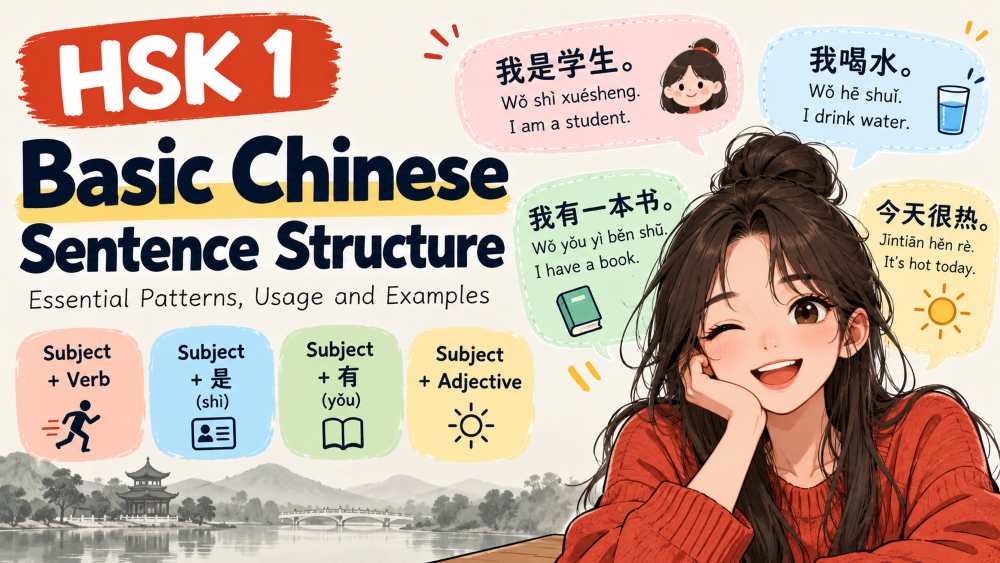
This HSK 1 grammar lesson covers four essential topics: basic Chinese word order, sentences with 是 (shì), sentences with 有 (yǒu), and sentences using adjectives.
1. Overview of Basic Chinese Sentence Patterns
The following five sentence patterns provide a foundation for building simple sentences in Mandarin Chinese.
| Sentence pattern | Purpose | Example |
|---|---|---|
| Subject + Verb | Express an action | 他工作。 / Tā gōngzuò. / He works. |
| Subject + Verb + Object | Express an action involving an object | 我喝水。 / Wǒ hē shuǐ. / I drink water. |
| Subject + 是 + Noun/Noun Phrase | Identify or classify someone or something | 我是学生。 / Wǒ shì xuésheng. / I am a student. |
| Subject + 有 + Object | Express possession | 我有一本书。 / Wǒ yǒu yì běn shū. / I have a book. |
| Subject + 很 + Adjective | Describe a quality or state | 今天很热。 / Jīntiān hěn rè. / It’s hot today. |
Each pattern serves a different purpose. Verb sentences describe actions, 是 sentences identify or classify people and things, 有 sentences express possession, and adjective sentences describe qualities or states.
One important difference between Chinese and English is that Chinese does not always require a verb equivalent to “to be” before an adjective.
2. Basic Word Order in Chinese Sentences
One of the most common sentence patterns in Mandarin Chinese follows Subject + Verb + Object (SVO) word order, just as many basic English sentences do.
However, not every Chinese verb requires an object. Some sentences contain only a subject and a verb, while others include an object to provide additional information.
2.1. Subject + Verb
Pattern: Subject + Verb
Some Chinese verbs can form complete sentences without an object.
Examples:
-
他工作。 / Tā gōngzuò. / He works.
-
我学习。 / Wǒ xuéxí. / I study.
-
她笑了。 / Tā xiào le. / She laughed.
In the sentence 他工作, 工作 (gōngzuò) describes what 他 (tā) does. No object is needed to complete the basic meaning.
Similarly, 我学习 tells us that the speaker studies, without specifying what subject they are studying.
This pattern is useful when the action itself is the main information you want to communicate.
2.2. Subject + Verb + Object
Pattern: Subject + Verb + Object
When a verb takes an object, that object normally appears after the verb in a basic Chinese sentence.
Examples:
-
我喝茶。 / Wǒ hē chá. / I drink tea.
-
他吃米饭。 / Tā chī mǐfàn. / He eats rice.
-
我学中文。 / Wǒ xué Zhōngwén. / I study Chinese.
-
她喜欢音乐。 / Tā xǐhuan yīnyuè. / She likes music.
Consider the sentence 我学中文:
-
我 (wǒ): subject — I
-
学 (xué): verb — study
-
中文 (Zhōngwén): object — Chinese
The object 中文 comes after the verb 学.
You can create new sentences by replacing individual words while keeping the same structure:
-
我喝水。 / Wǒ hē shuǐ. / I drink water.
-
你喝水。 / Nǐ hē shuǐ. / You drink water.
-
他喝水。 / Tā hē shuǐ. / He drinks water.
Notice that 喝 (hē) does not change when the subject changes. Unlike English verbs, which may take different forms such as “drink” and “drinks,” Mandarin Chinese verbs do not conjugate according to the subject.
Remember that SVO is a basic word-order pattern, not a universal rule for every Chinese sentence. Other structures become important when you learn to express time, location, questions, and emphasis.
3. Using 是 (shì) to Identify People and Things
是 (shì) is one of the most important verbs in beginner Chinese. It is commonly translated as “to be,” particularly when identifying someone or something, describing a person’s role, or classifying an object.
3.1. Sentence Pattern with 是
Pattern: Subject + 是 + Noun/Noun Phrase
Examples:
-
我是学生。 / Wǒ shì xuésheng. / I am a student.
-
他是老师。 / Tā shì lǎoshī. / He is a teacher.
-
她是我妈妈。 / Tā shì wǒ māma. / She is my mother.
-
这是我的书。 / Zhè shì wǒ de shū. / This is my book.
-
我们是朋友。 / Wǒmen shì péngyou. / We are friends.
In 我是学生, the noun 学生 (student) identifies the speaker. In 她是我妈妈, the noun phrase 我妈妈 (my mother) identifies the relationship between the person being discussed and the speaker.
You can use the same pattern with different nouns:
-
我是老师。 / Wǒ shì lǎoshī. / I am a teacher.
-
我是学生。 / Wǒ shì xuésheng. / I am a student.
-
我是中国人。 / Wǒ shì Zhōngguó rén. / I am Chinese.
The key is that 是 connects the subject to a noun or noun phrase that identifies or classifies it.
3.2. Why You Shouldn’t Use 是 Before Adjectives in Basic Descriptions
In English, adjectives commonly follow a form of the verb “to be”:
-
He is tall.
-
The weather is hot.
Mandarin Chinese works differently. Adjectives can function directly as predicates, so a separate linking verb like 是 is generally unnecessary in simple descriptive sentences.
For example:
他很高。 / Tā hěn gāo. / He is tall.
今天很热。 / Jīntiān hěn rè. / It’s hot today.
For ordinary neutral descriptions, beginners should not construct sentences such as 他是很高 or 今天是很热 by translating the English structure word for word.
This is a basic guideline rather than an absolute prohibition. At more advanced levels, 是 can appear with adjectives in particular emphatic or contrastive constructions.
4. Using 有 (yǒu) to Express Possession
有 (yǒu) commonly means “to have.” One of its most useful functions at HSK 1 level is expressing possession.
4.1. Sentence Pattern with 有
Pattern: Subject + 有 + Object
Examples:
-
我有书。 / Wǒ yǒu shū. / I have books.
-
他有一个妹妹。 / Tā yǒu yí ge mèimei. / He has a younger sister.
-
我有两个朋友。 / Wǒ yǒu liǎng ge péngyou. / I have two friends.
-
她有一只猫。 / Tā yǒu yì zhī māo. / She has a cat.
In 我有书, 有 connects the subject 我 (I) to the thing the speaker possesses, 书 (books).
To specify a quantity, Chinese commonly uses the structure:
Number + Measure Word + Noun
For example:
我有一本书。 / Wǒ yǒu yì běn shū. / I have one book.
Here, 一本书 consists of 一 (one), 本 (a measure word for books), and 书 (book).
Measure words are an essential part of counting objects in Mandarin Chinese. Their rules and usage will be covered in greater detail in a separate lesson on numbers and quantities.
4.2. Difference Between 是 and 有
Although 是 and 有 can appear in similar-looking sentences, they have different grammatical functions.
| Feature | 是 (shì) | 有 (yǒu) |
|---|---|---|
| Basic meaning | To be | To have |
| Main function | Identification or classification | Possession |
| Pattern | Subject + 是 + Noun/Noun Phrase | Subject + 有 + Object |
| Example | 我是老师。 / Wǒ shì lǎoshī. / I am a teacher. | 我有一本书。 / Wǒ yǒu yì běn shū. / I have a book. |
Use 是 when you want to identify or classify someone or something. Use 有 when you want to say that someone possesses something.
有 also has another important function: expressing existence at a particular location.
For example:
桌子上有一本书。 / Zhuōzi shang yǒu yì běn shū. / There is a book on the table.
This use of 有 will be explored further in the lesson on locations and positions.
5. Building Chinese Sentences with Adjectives
Mandarin Chinese adjectives can serve as predicates, allowing you to describe people, objects, weather, and conditions without adding a separate form of “to be.”
In basic affirmative sentences, 很 (hěn) commonly appears before the adjective.
5.1. Subject + 很 + Adjective
Pattern: Subject + 很 + Adjective
Examples:
-
她很漂亮。 / Tā hěn piàoliang. / She is beautiful.
-
他很高。 / Tā hěn gāo. / He is tall.
-
今天很热。 / Jīntiān hěn rè. / It’s hot today.
-
这个苹果很大。 / Zhège píngguǒ hěn dà. / This apple is big.
-
我很忙。 / Wǒ hěn máng. / I am busy.
In 今天很热, the adjective 热 (rè) describes the weather, while 很 (hěn) appears immediately before the adjective.
This pattern is one of the most useful ways to form simple descriptive sentences in Mandarin Chinese.
5.2. Does 很 Always Mean “Very”?
很 is often introduced as the Chinese equivalent of “very.” However, its function is more nuanced.
In neutral affirmative adjective-predicate sentences, 很 does not always express strong emphasis. Sometimes it simply helps make the description sound natural.
Consider:
她很漂亮。 / Tā hěn piàoliang. / She is beautiful.
Depending on the context and pronunciation, this sentence may simply describe the person as beautiful rather than strongly emphasizing the degree of beauty.
Similarly:
他很高。 / Tā hěn gāo. / He is tall.
This sentence does not necessarily mean that the person is exceptionally tall.
Without 很, a sentence such as 他高 may sound contrastive or require additional context.
However, 很 is not mandatory before every Chinese adjective. Adjectives can also appear with other degree adverbs, in comparisons, and in different sentence structures.
For beginners, Subject + 很 + Adjective is a reliable starting point for making neutral descriptions.
5.3. Common Chinese Adjectives
| Adjective | Pinyin | English meaning |
|---|---|---|
| 大 | dà | Big, large |
| 小 | xiǎo | Small |
| 好 | hǎo | Good |
| 高 | gāo | Tall, high |
| 热 | rè | Hot |
| 冷 | lěng | Cold |
| 忙 | máng | Busy |
| 漂亮 | piàoliang | Beautiful, pretty |
You can practice using these adjectives with different subjects. Just make sure the adjective logically matches the person or thing being described.
6. Common Mistakes in Basic Chinese Sentences
Many beginner mistakes happen because learners apply the same sentence pattern to different grammatical situations.
The following table highlights three common problems.
| Common mistake | Incorrect or unsuitable sentence | Correct sentence |
|---|---|---|
| Placing the object before the verb in a basic SVO sentence | 我中文学。 | 我学中文。 / Wǒ xué Zhōngwén. / I study Chinese. |
| Using 有 instead of 是 for identification | 我有学生。 (when intending “I am a student”) | 我是学生。 / Wǒ shì xuésheng. / I am a student. |
| Adding 是 before an adjective in a neutral description | 她是很漂亮。 | 她很漂亮。 / Tā hěn piàoliang. / She is beautiful. |
To avoid these mistakes, first identify what you want your sentence to express. Are you describing an action, identifying someone, expressing possession, or describing a quality?
Once you know the purpose, choosing the appropriate structure becomes much easier.
A useful practice method is to start with a model sentence and replace one word at a time.
For example:
-
我喝茶。 / Wǒ hē chá. / I drink tea.
-
我喝水。 / Wǒ hē shuǐ. / I drink water.
-
他喝水。 / Tā hē shuǐ. / He drinks water.
This exercise helps you become familiar with Chinese word order while expanding your vocabulary.
Conclusion
Understanding basic Chinese sentence structure is an essential foundation for HSK 1 grammar. By learning common word-order patterns and the different functions of 是, 有, and adjective predicates, you can begin forming meaningful sentences for everyday communication.
Focus on understanding how each pattern works rather than memorizing formulas in isolation. Practice changing subjects, verbs, nouns, and adjectives to create your own examples. Once these basic structures become familiar, you will be better prepared to learn Chinese questions, negative sentences, and more advanced sentence patterns.