
Have you ever felt insecure about yourself? I used to think a few words of encouragement would make me feel better, but then I realized: insecurity doesn’t live in your ears to be wiped away by a few nice phrases. It runs much deeper, rooted in the times you were criticized, compared, or overlooked, and in the feeling of being habituated to believing that you are not good enough.
1. Words of encouragement touch the surface, while insecurity lies deep underneath
Insecurity rarely develops overnight. It is usually pieced together from many tiny fragments: a time you were criticized in front of a crowd, a childhood filled with comparisons, an environment that constantly glorified those who were better than you, or a long period where you tried your best but went unnoticed by everyone.
At first, those instances are just a few scratches. But if they repeat long enough, they become the lens through which you view yourself. You were once criticized for speaking poorly, so now you hesitate to voice your opinion. You once failed and were laughed at, so it becomes incredibly hard to believe that you could do any better next time. You once tried so hard but received no recognition, so gradually, you stop believing in your own efforts altogether.
Therefore, when someone tells you: “Just be confident,” the statement sounds correct, but it is not enough to provide a genuine breakthrough.
It is like placing a clean cloth over an unwashed wound. It might look better on the outside, but it still throbs underneath.
Sadly, overly generic words of cheer can sometimes make you feel even lonelier, because you get the sense that your fears are being dismissed. When someone says, “But you’re good at this,” you don’t feel relieved; instead, you just wonder, “What exactly am I good at? What if I mess it up?” When someone says, “Don’t overthink it,” you feel like even more of a nuisance, because you can’t even manage to stop thinking.
The issue isn’t that the person offering encouragement has bad intentions. Most of them genuinely want you to feel better. But there are phrases that only touch the surface layer of emotion, whereas insecurity operates at a much deeper level: a place where you have already grown accustomed to doubting yourself before anyone else even has a chance to judge you.
You don’t need to be overly praised or flattered just to be placated. You need to be seen accurately.
You need a fair mirror—one that points out the specific thing you did well, a single instance where you tried your best, or a quiet quality that you yourself often overlook. You might not stand out in a crowd, but you are a good listener. You might not speak eloquently, but you work responsibly. You might not be great at self-promotion, but once you accept a task, you usually see it through to the end.
A phrase like: “You did this part quite solidly, you just need to revise the very end” is sometimes infinitely more helpful than “You’re amazing.” Because it doesn’t sugarcoat you. It shows you exactly where you are good, where you are lacking, and how you can take the next step forward.
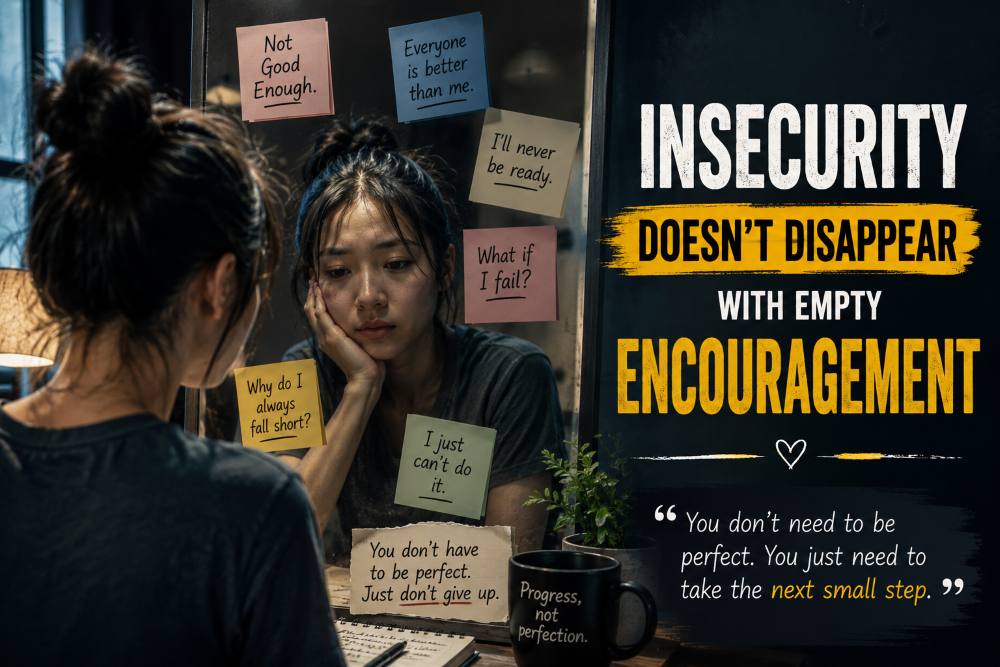
2. Insecurity only eases when you have new experiences to replace old beliefs
You cannot change simply by hearing that you should be more confident. You need new experiences.
If you previously believed that speaking up would always lead to mistakes, you need one instance where you dare to speak and realize the world doesn’t collapse. If you believe you are always incompetent, you need to complete a small task to see that you are still capable. If you believe everyone is staring at your weaknesses, you need to step outside a few times and realize that not every pair of eyes is scrutinizing you.
Confidence doesn’t come from loudly telling yourself that you are great. Confidence comes from the very small moments where you prove to yourself: I can do it, I can fix it, I can learn, and I can endure the feeling of being imperfect without running away.
If you are afraid of public speaking, start by sharing a brief point in a small meeting. If you are afraid of criticism, start by submitting an imperfect rough draft. If you always feel useless, start by writing down the very small things you accomplished during the day.
Those things might not sound incredibly grand, but that is the moment you rebuild your self-trust using real materials.
There are times when a reminder like: “This is really tough, but I’ll try the smallest part first” is far more useful than words of cheer. Because it doesn’t deny your fear. It just doesn’t allow fear to dictate your entire course of action.
You don’t have to take a massive leap to prove that you have changed. Sometimes all it takes is a small but steady step: sending a draft, voicing an opinion, accepting a manageable task, or trying again after a mistake.
Each time you do, you are quietly telling yourself: “I am still afraid, but I am not completely helpless.”
And it is precisely those small experiences that shake the foundations of insecurity. Not through loud applause from the outside, but through tiny pieces of evidence accumulating on the inside.
3. Insecurity doesn’t just naturally disappear
Insecurity doesn’t disappear by waking up one morning and deciding to love yourself. It gradually recedes when you are brave enough to look back at old beliefs, courageous enough to create new experiences, and fair enough to realize that you are not defined solely by what you lack.
Give yourself the grace to walk slowly, to try again, and to make a few mistakes without rushing to the conclusion that you are incompetent. You don’t need to force yourself to be confident right away. You don’t need to transform into a radiant version of yourself after just a few self-affirmations.
Instead of forcing yourself to say, “I am very confident,” perhaps you just need to start with a more honest sentence: “I am scared, but I will try the smallest part first.”
For someone dealing with insecurity, the truth is sometimes more healing than beautiful words.
Start small: look back at a task you actually managed to complete, a time you pulled through, even if no one clapped. Maybe it was your persistence. Maybe it was your responsibility. Maybe it was your ability to listen. Maybe it was the fact that you continued to live kindly, even when you often didn’t believe there was anything special about you.
Belief in oneself sometimes doesn’t return through grand declarations. It returns very quietly, after each time you refuse to give up on yourself.
Conclusion
Insecurity is not a mild bout of sadness that can be swept away with a few pleasant-sounding phrases. It is the result of hundreds of times you were pulled away from believing in yourself.
Encouragement isn’t wrong. But encouragement is only truly useful when it helps you see a concrete foothold to take the next step.
Have you ever received a piece of encouragement that sounded wonderful but didn’t help you feel any better? And what was the thing that actually made you start believing in yourself a little more? Please share it with me in the comments below.
See more: Why Do You Struggle with Insecurity?