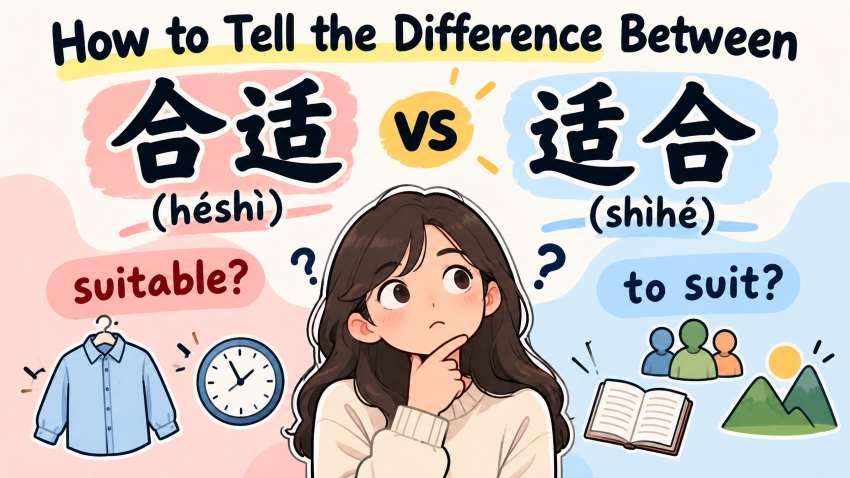
At first glance, 合适 (héshì) and 适合 (shìhé) are very easy to confuse. They contain the same two Chinese characters in reverse order, and dictionaries often translate both as “suitable,” “appropriate,” or “to suit.” However, they do not work in exactly the same way in a sentence. The easiest way to tell them apart is not to memorize two slightly different English definitions. Instead, look at the role each word plays in the sentence and what comes after it.
合适 describes something as suitable, while 适合 often tells you what it suits
The most useful difference to remember is this:
合适 (héshì) usually works like an adjective. It describes something as suitable, appropriate, or a good fit.
适合 (shìhé) usually works more like a verb. It tells you that something suits a person, situation, activity, or purpose.
Compare these two sentences:
这个时间很合适。 (Zhège shíjiān hěn héshì.) – This time is suitable.
这个时间适合开会。 (Zhège shíjiān shìhé kāihuì.) – This time is suitable for having a meeting.
In the first sentence, 合适 simply describes the time as suitable.
In the second sentence, 适合 tells us what the time is suitable for: 开会, having a meeting.
You can see the same difference with clothes:
这件衣服很合适。 (Zhè jiàn yīfu hěn héshì.) – This piece of clothing is suitable / fits well.
这件衣服很适合你。 (Zhè jiàn yīfu hěn shìhé nǐ.) – This piece of clothing suits you very well.
The second sentence gives us an extra relationship: the clothes are suitable for you.
This is why 适合 can often be followed directly by the person or thing that something suits:
这个颜色适合你。 (Zhège yánsè shìhé nǐ.) – This color suits you.
这本书适合初学者。 (Zhè běn shū shìhé chūxuézhě.) – This book is suitable for beginners.
这个地方适合学习。 (Zhège dìfang shìhé xuéxí.) – This place is suitable for studying.
这个工作适合他。 (Zhège gōngzuò shìhé tā.) – This job suits him.
With 合适, you would normally structure the sentence differently rather than simply placing an object directly after it.
Put them side by side and the difference becomes much clearer
One of the easiest ways to remember these two words is to compare them in the same situation.
Take the word 工作 (gōngzuò) – job.
我想找一份合适的工作。 (Wǒ xiǎng zhǎo yí fèn héshì de gōngzuò.) – I want to find a suitable job.
Here, 合适 comes before the noun with 的 and describes what kind of job the speaker wants: a suitable one.
Now compare it with:
这份工作很适合我。 (Zhè fèn gōngzuò hěn shìhé wǒ.) – This job suits me very well.
Here, 适合 connects the job with the person it suits: 我, me.
The same pattern appears with people:
我们需要找一个合适的人。 (Wǒmen xūyào zhǎo yí ge héshì de rén.) – We need to find a suitable person.
他很适合这个职位。 (Tā hěn shìhé zhège zhíwèi.) – He is very suitable for this position.
Again, 合适的人 means “a suitable person,” while 适合这个职位 means “suitable for this position.”
You can also compare them with time:
这个时间很合适。 (Zhège shíjiān hěn héshì.) – This time works well.
这个时间适合我们开会。 (Zhège shíjiān shìhé wǒmen kāihuì.) – This time is suitable for us to have a meeting.
Or with a place:
这个地方很合适。 (Zhège dìfang hěn héshì.) – This place is suitable.
这个地方很适合拍照。 (Zhège dìfang hěn shìhé pāizhào.) – This place is great for taking photos.
The first sentence simply evaluates the place. The second tells us what the place is suitable for.
This is also why expressions such as these are very common:
合适的人 (héshì de rén) – a suitable person
合适的时间 (héshì de shíjiān) – a suitable time
合适的工作 (héshì de gōngzuò) – a suitable job
but with 适合, you often see something following it:
适合你 (shìhé nǐ) – suit you
适合孩子 (shìhé háizi) – suitable for children
适合学习 (shìhé xuéxí) – suitable for studying
适合做这个工作 (shìhé zuò zhège gōngzuò) – suitable for doing this job
A simple way to avoid mixing them up
The mistake usually happens because both words are translated into English as “suitable.”
If you only memorize:
合适 = suitable
适合 = suitable
then there is almost nothing to help you choose between them.
A more useful question is:
Am I simply describing something as suitable?
If yes, 合适 is often what you need.
这个时间很合适。 (Zhège shíjiān hěn héshì.) – This time is suitable.
这个大小很合适。 (Zhège dàxiǎo hěn héshì.) – This size is just right.
我还没找到合适的房子。 (Wǒ hái méi zhǎodào héshì de fángzi.) – I still haven’t found a suitable apartment.
But if you are saying:
suitable for whom?
suitable for what?
suitable for doing what?
then 适合 is usually the word to think of.
这双鞋很适合你。 (Zhè shuāng xié hěn shìhé nǐ.) – These shoes suit you very well.
这本书适合儿童阅读。 (Zhè běn shū shìhé értóng yuèdú.) – This book is suitable for children to read.
这里不适合停车。 (Zhèlǐ bù shìhé tíngchē.) – This is not a suitable place to park.
One mistake to avoid is trying to use 合适 exactly like 适合 and placing an object directly after it. For example, if you want to say “This suits me,” the natural structure is:
这个适合我。 (Zhège shìhé wǒ.) – This suits me.
rather than treating 合适 as a verb that directly takes 我 after it.
That does not mean every sentence with these two words can be reduced to one rigid formula. Real language always has more flexibility than a simple rule. But for learners, this distinction is a very useful starting point.
If you only want one pair of sentences to remember the difference, I think these two are enough:
我想找一份合适的工作。 (Wǒ xiǎng zhǎo yí fèn héshì de gōngzuò.) – I want to find a suitable job.
这份工作很适合我。 (Zhè fèn gōngzuò hěn shìhé wǒ.) – This job suits me very well.
In the first sentence, 合适 describes the job.
In the second, 适合 tells us who the job suits.
Once you start noticing that pattern, 合适 and 适合 become much easier to tell apart.