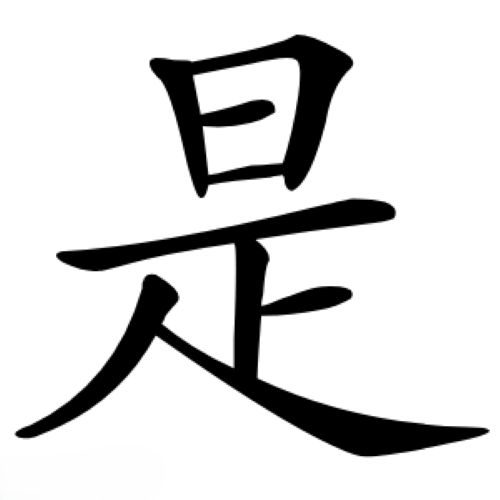
是 (shì) is a very basic word in Chinese, so most learners encounter it quite early. The confusing part is not the basic A 是 B structure, but the situations where we think we should use 是 when we actually should not, or where 是 is used with a different nuance. Below are a few points that I think are worth paying attention to when using 是.
Don’t automatically use 是 whenever you see “am / is / are”
This is probably one of the easiest mistakes to make if you are used to thinking from English into Chinese.
In English:
“I am tired.”
“She is beautiful.”
“It is cold today.”
All of these sentences contain am / is, but in Chinese, descriptive sentences with adjectives like these usually do not need 是.
我很累。 (Wǒ hěn lèi.) – I am tired.
她很漂亮。 (Tā hěn piàoliang.) – She is beautiful.
今天很冷。 (Jīntiān hěn lěng.) – It is cold today.
So if you simply want to say “I am tired,” do not see “I am” and automatically turn it into 我是很累.
Another point that often confuses beginners is 很 (hěn) in sentences like 我很累. In simple adjective sentences, 很 appears very frequently and does not always need to be understood strongly as “very.” Depending on the context, 我很累 can simply mean “I am tired.”
However, you should not turn this into an absolute rule that 是 can never appear before an adjective.
You may still see:
我是很累,但是我还得工作。 (Wǒ shì hěn lèi, dànshì wǒ hái děi gōngzuò.) – I am indeed tired, but I still have to work.
Here, 是 adds emphasis, something closer to “indeed” or “it is true that,” rather than functioning like the regular 是 in 我是学生.
Location, existence, and age usually do not need 是
Another situation where learners are easily influenced by “to be” is when talking about where someone is.
“I am at school.”
Chinese does not form this by combining “I + 是 + school.” Instead, it uses 在 (zài):
我在学校。 (Wǒ zài xuéxiào.) – I am at school.
他在家。 (Tā zài jiā.) – He is at home.
老师在办公室。 (Lǎoshī zài bàngōngshì.) – The teacher is in the office.
But this does not mean that you should understand it as “you can never use 是 when talking about places.”
For example:
这里是学校。 (Zhèlǐ shì xuéxiào.) – This is a school.
This sentence can still use 是 because we are identifying what 这里, “this place,” is. We are not saying where a person or object is located.
Another case is when talking about something existing in a place. In this situation, you will often use 有 (yǒu):
桌子上有一本书。 (Zhuōzi shàng yǒu yì běn shū.) – There is a book on the table.
学校旁边有一家咖啡店。 (Xuéxiào pángbiān yǒu yì jiā kāfēidiàn.) – There is a coffee shop next to the school.
Age also does not require 是 just because English uses “am / is.”
我二十岁。 (Wǒ èrshí suì.) – I am twenty years old.
他今年十八岁。 (Tā jīnnián shíbā suì.) – He is eighteen years old this year.
These examples show an important point: 是 is not a fixed translation of “to be.” Before using 是, it helps to look at what the sentence is actually expressing: identity, location, existence, or age.
Pay attention to 不是, 是不是, and negative questions
The negative form of 是 is 不是.
他不是老师。 (Tā bú shì lǎoshī.) – He is not a teacher.
我不是中国人。 (Wǒ bú shì Zhōngguó rén.) – I am not Chinese.
这不是我的。 (Zhè bú shì wǒ de.) – This is not mine.
One small but important detail is the pronunciation of 不. Normally, 不 is pronounced bù, but before a fourth-tone syllable such as 是 (shì), it is pronounced bú.
So:
不是 → bú shì
rather than naturally pronouncing it as bù shì.
You will also see 是不是 very often in questions:
你是不是学生? (Nǐ shì bu shì xuésheng?) – Are you a student?
他是不是你的老师? (Tā shì bu shì nǐ de lǎoshī?) – Is he your teacher?
This is an A-not-A question pattern, meaning that both the affirmative and negative forms appear in the same question.
You may also see:
你不是学生吗? (Nǐ bú shì xuésheng ma?) – Aren’t you a student?
他不是你的朋友吗? (Tā bú shì nǐ de péngyou ma?) – Isn’t he your friend?
Questions like these are often not completely neutral. Depending on the context and tone of voice, they can express confirmation, surprise, or even a slightly challenging tone.
For example, you may have thought someone was a student, but then notice that they seem to go to work every day. In that situation, 你不是学生吗? sounds natural because you are confirming something that you previously believed to be true.
Don’t translate 是……的 word by word
Another structure that can easily cause confusion is 是……的.
For example:
我是昨天来的。 (Wǒ shì zuótiān lái de.) – I came yesterday.
If you try to translate 是 = am word by word, this sentence becomes very difficult to understand.
In this structure, 是……的 is often used to highlight a particular detail of an event, such as time, place, or manner.
我是昨天来的。 (Wǒ shì zuótiān lái de.) – I came yesterday. Here, the emphasized part is 昨天 – yesterday.
我是在北京认识他的。 (Wǒ shì zài Běijīng rènshi tā de.) – I met him in Beijing. The emphasized part is 在北京 – in Beijing.
我是坐飞机来的。 (Wǒ shì zuò fēijī lái de.) – I came by plane. Here, the focus is 坐飞机 – by plane.
So when you see 是……的, do not immediately apply the basic meaning of 是. Look at the whole structure and ask what piece of information it is emphasizing.
The point I think is most worth remembering about 是 is not the basic A 是 B formula, but avoiding the habit of treating it as a word that can be inserted anywhere English uses “am / is / are.”
我很累。 (Wǒ hěn lèi.) – I am tired.
我在学校。 (Wǒ zài xuéxiào.) – I am at school.
我二十岁。 (Wǒ èrshí suì.) – I am twenty years old.
All three English sentences contain a form of “to be,” but none of the Chinese sentences needs 是.
If you remember this point, you can avoid quite a few mistakes with 是, especially if you tend to translate sentences word for word from English into Chinese.