
Blog

  • The Key to Opening Your Heart After Being Hurt

    I used to have a very close friend—at least, that’s what I always believed. They were the only person I felt I could be my truest self with: from my tiny anxieties and random thoughts to the vulnerable parts I usually hide behind a tough exterior.

    I trusted them because they always listened intently. I trusted them because their responses were always so timely. I trusted them because I felt genuinely understood. Until one day, I realized with a shock: I had trusted the wrong person.

    When the hurt comes from trust

    This wound didn’t come from a heated argument or bitter words. It was simply the discovery that the most private things I had shared were being distorted, retold behind my back, or worse, used for purposes I never agreed to.

    At that moment, I felt a profound sadness, a sense of betrayal mixed with a surge of rage. I wanted to run straight to them and give them a piece of my mind. But once I calmed down, I understood: they hadn’t necessarily set out to deceive me from the start. They simply didn’t value the trust I placed in them. To put it bluntly: they never considered me a close friend.

    It was that mismatch in our definitions of friendship that truly hurt.

    “The most painful thing isn’t being lied to; it’s realizing you were wrong about your place in someone else’s heart.”

    The silent collapse of faith

    After that, what haunted me wasn’t the lie itself, but the misconception. I thought we were each other’s emotional anchors, but to them, I was just someone “convenient to talk to.” They listened out of curiosity about my private life, or simply to have another piece of gossip for the dinner table. The things I poured my heart out to say weren’t necessarily things they felt like protecting.

    That feeling is hard to name. It’s not quite anger, and it’s not entirely sadness. It feels like a massive disappointment—a quiet, internal collapse of faith.

    Closing the doors after being hurt

    From then on, I became much more guarded. I still talked, I still smiled, but I stopped sharing much about myself. I kept my distance even from acquaintances. A question kept looping in my mind: “Is this person actually trustworthy?”

    I called it self-protection. But looking deeper, it was a fear of opening up again. I was afraid that if I trusted someone else, I’d once again be the naive one being laughed at behind my back.

    But I soon realized: locking the door didn’t make me safer. I asked myself: “If I keep everything to myself like this, will I really be okay?” The answer was no.

    Building selective trust

    Shutting my heart tight didn’t make me stronger; it only isolated me from the world. I might have been safe from more hurt, but I also lost the ability to truly connect with people. I understood then that the problem wasn’t whether I should open up, but how.

    I started learning how to build selective trust. I learned to distinguish between someone who is a good listener and someone who is a good secret-keeper.

    “Not everyone who is interested in your story deserves the full truth of who you are.”

    Some relationships are only meant for “surface-level” sharing. I stopped telling everything from the very beginning. I let time answer the questions for me: How does this person react to sensitive information? Do they respect boundaries? Do they keep things that don’t belong to them private?

    Opening up without losing yourself

    I began to open up again, but I didn’t force myself to trust immediately. I allowed myself to go slow. I allowed myself to keep a part of my life private, and that doesn’t make me cold or selfish.

    I understand now: trusting people isn’t a mistake. But trusting the right person at the right level is what matters. Opening up doesn’t mean giving away everything you have; it means sharing with clarity and awareness.

    “Opening up isn’t about exposing every wound; it’s about bravely choosing the person worthy of healing them with you.”

    After everything, I don’t regret having trusted. If I could go back, I would still choose to be someone who dares to believe. Because that “mistake” taught me how to read people better, how to understand myself more, and how to cherish true trust more than ever before.

    That hurt didn’t close off my life. It just made me open up in a way that is more mature and grounded. And perhaps, that is the true key to finding genuine connections in this world.

    Have you ever placed your trust in the wrong person like I did? Don’t be afraid to share your story below. Every experience is a lesson that makes us stronger.

  • Love and Possession: When Caring Becomes a Chain

    I have a close friend. She once told me about a relationship that, at first glance, anyone would have called “the gold standard of love”: passionate care, a deep bond, and a constant desire to be together.

    In the beginning, my friend was incredibly happy. She had someone texting to check in every morning, someone who knew where she was, what she was doing, and who she was with. She told me, “It’s been a long time since I felt this needed.” At the time, I was happy for her, too.

    “The line between caring and controlling is razor-thin; sometimes we only realize it when our feet are already weary.”

    When care starts to “change its flavor”

    After a while, my friend confided that her partner started asking more questions. But it was no longer casual curiosity; they were… “interrogations.” He’d ask for every detail of where she went, demand to know everyone she met, and if she was even a little late, he required a “valid” excuse.

    Whenever she showed discomfort, he would just say softly:

    • “I only care because I love you.”
    • “If we’re in love and I don’t know these things, what’s the point?”

    It sounded reasonable enough, and my friend chose to believe him.

    Possession without words

    But over time, that “care” became excessive. The scariest part was that there were never any explicit forbidden rules. He never said, “You aren’t allowed to do this,” but in some invisible way, my friend felt she had to adjust herself.

    She started seeing her friends less, restricted her own conversations with the opposite sex, and even second-guessed herself for a long time before making any personal decisions. No one gave an order, yet my friend began living as if she belonged entirely to someone else.

    When love turns into “holding on tight”

    Once, my friend got a new job opportunity—teaching at a prestigious high school. It was something she had been dreaming of. But her partner’s first reaction wasn’t a “Congratulations”; it was a series of possessive questions:

    • “A long-distance relationship?”
    • “Will you even have time for me anymore?”

    Those questions made her freeze. Not because they were wrong, but because they exposed a glaring truth: his biggest worry wasn’t her stress or her exhaustion—it was the fear of losing his control over her life.

    That was when she began to understand: some people don’t love you because they want to see you grow; they love you because they want to keep you within their reach.

    Possession disguised as “Sacrifice”

    My friend said he often brought up how much he had “given up” for the relationship: giving up friends, giving up habits, giving up personal opportunities. Every time she heard this, she felt an overwhelming sense of guilt. Gradually, that guilt turned into a sense of debt: “He did all this for me, so I have to stay.”

    But the longer she stayed, the more exhausted she became. Because at this point, the love was no longer voluntary—it had become an “emotional debt” she had to pay off.

    “Love is never a debt, and you are under no obligation to pay for it with your own freedom.”

    The moment she realized she had disappeared

    One day, my friend sat across from me and said something very brief, but deeply painful:

    “I don’t know at what point I started having to ask for permission just to live my own life.”

    That sentence kept me silent for a long time. She hadn’t been hit, she hadn’t been yelled at, and she hadn’t been explicitly forbidden from anything. But she had been led to believe that love meant belonging to someone else entirely. In the end, she chose to break up.

    After the relationship ended, she said something I’ll always remember: “Love is wanting the other person to freely choose you every day. Possession is being so afraid they’ll choose something else that you have to hold them as tight as you can.”

    My friend’s story taught me a new lesson about love. Genuine love doesn’t tie people down, it doesn’t strip away the right to decide, and it absolutely never turns “caring” into an invisible chain.

    If a relationship causes you to gradually “disappear” from your own life, then it might not be love—it might just be possession under a prettier name.

    “True love is when two people stand side-by-side, looking in the same direction—not when one person locks the other in their own glass cage.”

    The boundary between caring and possession is fragile. Have you ever felt yourself “disappearing” in a relationship in the name of love? Feel free to share your story or perspective below, because sometimes, just speaking the truth is how we find our way back to freedom.

  • Loving Someone vs. Loving the Feeling of Being Loved

    I was once in a relationship that, from the outside, looked perfect. They were attentive, texted regularly, remembered every anniversary, and were always there when I was tired. My friends told me how lucky I was, and I convinced myself that I should be happy.

    But then came those evenings when my phone lit up with a familiar text, and I no longer felt that spark of excitement. I replied out of politeness, out of habit, and out of fear of hurting them—not because I genuinely wanted to share my day. That’s when I started to wonder: Do I actually love this person, or do I just love the feeling of being loved?

    The addiction of being someone’s priority

    The feeling of being loved is incredibly addictive. It makes us feel valuable, chosen, and prioritized. When someone listens to us and dedicates their time to us, it’s very easy to mistake that satisfaction for love.

    But gradually, I realized I was looking forward to the “actions” more than the “person” behind them. I liked the feeling of having someone to text every night; I liked being picked up and looked after. But if I imagined spending a long day just sitting next to them with nothing special to do, I felt a strange sense of emptiness.

    “When we love the feeling of being loved, we are only loving the mirror that reflects our own worth—not the person holding the mirror.”

    The signs of a “situational” love

    One afternoon, they were excitedly telling me about something they were passionate about—I think it was a movie. I sat there, nodding and smiling, but my mind was miles away. I wasn’t curious, and I didn’t want to dive deeper into their story.

    In that moment, I had an epiphany:

    • If this were love, I would want to understand more.
    • If this were love, I would care about their inner world, not just the “services” they provided for me.

    Up until then, it had always been about what I liked, what I wanted to eat, and where I wanted to go. I took it all for granted without ever truly asking what they were struggling with in their own heart.

    Real love embraces the things that don’t “serve” you

    Looking back, when I have truly loved someone, the feeling was entirely different. I didn’t just want to be there for the highlights. I wanted to stay even when they were sad, exhausted, or cranky. I cared about things that had zero direct benefit to me: their career, their fears, and their silent battles.

    But when you only love the feeling of being loved, you start to get annoyed when your partner lacks the energy to “serve” your emotional needs. When they’re busy, tired, or need care in return, you feel let down or even disappointed. At that point, the relationship isn’t a connection between two souls; it’s one person chasing a feeling and the other straining themselves to provide it.

    “True love begins when the initial high fades and you still want to protect the other person’s vulnerability.”

    Choosing to stop, even when no one was at fault

    The hardest part was admitting that neither of us had done anything wrong. They had loved me with everything they had. As for me, I simply realized I was there for the safety, not for the soul.

    I chose to walk away, not because there was a lack of affection, but because I didn’t want to continue a relationship based on a misunderstanding. Staying when you only love “the feeling” will eventually break both hearts.

    “It is better to let someone be alone than to stay together and leave both people feeling empty.”

    After that experience, whenever someone knocks on the door of my heart, I ask myself one simple question: “Would I still care about this person even if they weren’t making me feel good right now?”

    If the answer is yes, it might be love. But if I only feel empty because I’m not being pursued, then I’m likely just craving the feeling of being loved. The two are more different than we think.

    Have you ever woken up and realized you were mistaking your own feelings? Don’t be afraid to face the truth; only by being honest with yourself can you find a love that is real.

  • The First “No”: When Rejection Brings Freedom

    After realizing I had spent far too long living for the praise of being “useful,” I decided to change. I started learning how to say no. But honestly, knowing you need to say no and actually having the words leave your mouth are two very different things.

    For me, saying “No” for the first time wasn’t easy—especially when everyone around you has already labeled you as the “automated response machine” that always hits the “Yes” button.

    The weight of “Just this once”

    One day, a colleague asked me to help her with an Excel file for client debts. It wasn’t my job, but it wasn’t outside my skill set either. The request sounded so familiar: “You’re better at Excel, could you just handle this for me?”

    I looked at my calendar; it was packed. I knew perfectly well that if I agreed, I’d be up all night working, cutting into my precious rest time while telling myself that same old lie: “It’s okay, I’ll just power through it.” I had used that phrase to deceive myself far too many times.

    “Every time you say ‘Yes’ to someone else when you really want to say ‘No,’ you are stealing time from yourself.”

    A battle between habit and freedom

    I sat there staring at the screen, fingers poised over the keyboard, ready to type an acceptance just like a thousand times before. But suddenly, a vivid image of my exhausted self dragging my body home late at night flashed before my eyes.

    I understood that if I kept nodding, I wasn’t just taking on more work—I was confirming to the world that my time and energy were cheap, available for the taking at any moment. But if I said “No,” I feared being labeled as “unapproachable” or “unenthusiastic.” For someone new to the workforce, that fear of judgment is paralyzing. But I was truly, deeply exhausted.

    The surprising silence after the refusal

    For the first time, I chose to decline politely. I took a breath and replied without making excuses or shifting blame. I just told the truth: “I don’t have enough time to do a thorough job on this file right now, so I’m going to have to pass.”

    After hitting send, my heart was racing. I held my breath, waiting for a negative reaction or a guilt trip. But the reality was incredibly anticlimactic: there was total silence. No one got angry; no one made a scene. And of course, there was no praise either. The most important thing was that I felt an incredible sense of relief.

    Saying “No” isn’t selfish—it’s responsible

    I used to think that saying no meant letting people down. But this experience taught me that saying “No” at the right time is how I respect both myself and the quality of my work.

    If I take on a task and do a sloppy job because I’m overloaded, that is being irresponsible. When I decline because I know I can’t give it my best, that is honesty. Saying “No” doesn’t make me a difficult person; it makes me someone with boundaries, responsibility, and courage.

    “You don’t need to use exhaustion to prove your worth. Your value lies in the quality of what you do, not the quantity of what you accept.”

    Lessons on boundaries and enthusiasm

    I’ve drafted some new rules for my life:

    • I don’t need to give long-winded explanations.
    • I don’t need to apologize for protecting my private time.
    • I don’t need to trade my exhaustion for validation.

    Saying “No” isn’t about clever communication techniques; it’s about daring to put yourself on your own priority list. Always taking on extra work doesn’t make you more “reliable”—it just makes people assume you’re always free and always willing to suffer. When you finally collapse from the burnout, no one is going to carry that weight for you.

    People only remember that “you got it done”; they don’t remember “how much it cost you” to do it. They praise you when you’re useful, not because they truly see you.

    Final Thoughts

    Now, whenever someone asks for a favor, my “automatic yes” reflex is gone. I pause and ask myself: “Do I have the energy for this? Is this actually my responsibility?” If the answer is no, I decline—gently, clearly, and absolutely without guilt.

    Lightening your own load isn’t “slacking off”—it’s how you live a life worth living.

    Have you ever wondered if you’re living for someone else’s satisfaction or your own happiness? When was the last time you were brave enough to say “No”? Remember, every time you turn down something that isn’t right for you, you are saying “Yes” to yourself. Do you have the courage to start today?

  • Don’t Let Old Fears Dictate New Limits

    I know how to swim—at least, in theory. But for years, every time I stood before the ocean, my feet would freeze. It wasn’t a fear of deep water; it was an old, cold memory that would suddenly surface and take over my mind.

    I remember that summer when I was 15 in Nha Trang as if it were yesterday. In the excitement of youth, I swam far out from the shore, completely unaware of the danger lurking nearby. A rogue wave suddenly crashed down on me, sweeping me several yards further out. The sensation of swallowing water, the suffocating panic, and my hands flailing helplessly in the vast ocean—it was a terror that words can’t describe. Even though the rescue team pulled me to shore in time, that feeling of being completely out of control was etched into my soul.

    The event ended long ago, but the fear stayed behind, as vivid as if it happened this morning.

    “Memory can be a sanctuary, but it can also be a prison for our courage.”

    When fear arrives before the action

    After that incident, I hated the beach. I turned down every invitation from the ocean. That is, until the day my company organized a team-building trip at the shore. As a new employee, I was desperate to fit in, but that location was a “forbidden zone” in my heart. I almost gave up, but it was my father’s encouragement that gave me the nerve to stand before the waves once more.

    Standing there after all those years, the obsession came rushing back. I wasn’t thinking about how far I could swim; I was only terrified that I would lose control again. Every tiny wave lapping at the shore was enough to make my heart race.

    I realized that fear doesn’t wait for you to fail before it shows up. It stands there, whispering in your ear before you even begin: “Don’t risk your life,” or “It’s safer on the shore.” And so I stood there, watching everyone play in the water, while I tried to convince myself: “It’s fine, it’s too dangerous anyway; it doesn’t matter if I don’t swim.”

    The waves weren’t the thing stopping me

    I eventually asked myself: Am I actually afraid of the water? Or am I afraid of repeating that feeling of being swept away?

    The more I thought about it, the clearer it became: what made me hesitate wasn’t the blue sea, but the memory tied to a past failure. My body remembered the pain perfectly, and it reacted by instinct before my logic could intervene. This fear is just like any other fear in life: fearing a new job because you blew the last one; fearing a new relationship because you’ve been hurt; fearing failure so much that you choose to stand still forever.

    “We are rarely afraid of the present; we are just afraid of the ghosts of the past returning.”

    Learning not to force an immediate “win”

    Seeing me standing silently on the sand, a colleague walked over and whispered, “Are you afraid of the waves?” When I stayed silent, they continued, “Don’t be afraid. You don’t have to go into the ocean right now. Just daring to stand a little closer to the water’s edge is enough to win against yourself.”

    That sentence woke me up. They were right—I didn’t need to swim out into the deep immediately. I just needed to stop letting fear make all my choices for me. Remembering my father’s words—“I believe you are strong enough to face this”—I gathered all my courage and slowly stepped toward the water’s edge.

    Lessons from footsteps in the sand

    I’ve learned this: fear doesn’t disappear when we deny it; denial only makes it stronger. Every small step we take to try again is a declaration to ourselves: the past is over, and the present is a completely different chapter.

    I don’t need to prove I’m the bravest person there. I just need to stop letting fear define my limits.

    “Courage isn’t the absence of fear, but being afraid and walking forward anyway.”

    Now, every time I stand before the sea, there are still ripples of anxiety in my heart. But I can finally see the beauty of the ocean; I can love it and go into the water with everyone else. The sea is the same, but I am different.

    Each of us has a “deep water” zone in our hearts—a memory that makes us hesitate. Are you standing on the shore watching life pass you by because of an old fear? Try moving closer to the water’s edge, just an inch at a time. You’ll find that the ocean isn’t actually as scary as your memory says it is.

  • Fear of Success: When Things Go Too Well

    I started freelance video editing by pure accident. In the beginning, I was just helping out an acquaintance, cleaning up a few frames here and there. No contracts, no expectations. I thought simply: get it done, earn a little coffee money, and call it a day.

    At that time, I was completely fearless. Mostly because I had nothing to lose.

    But things took a turn when that first client referred me to a second, and then a third. When the work stopped being “just for fun,” my mindset started to shift.

    The safety net of being an “Amateur”

    In the early stages, I was afraid of doing a bad job, afraid of criticism, and afraid of unhappy clients. But if any of that actually happened, I had the perfect shield to comfort myself: “I’m not a professional, anyway.”

    There was a strange comfort in that sentence. I worked on instinct, without pressure, and without looking too far ahead. Failure, if it happened, would only prove one thing: I wasn’t cut out for this line of work. That’s it.

    “Sometimes, the ‘just for fun’ label is the safest hideout we have to escape the pressures of growing up.”

    When success is no longer a fluke

    After a few smooth projects, old clients came back and new ones offered long-term collaborations. By this point, my skills were good enough to handle the work; the fear of “not being able to do it” had vanished. But in its place, a new set of fears emerged:

    • If I take on more, will I burn out?
    • If clients are used to this quality, can I maintain this streak for long?
    • If I get serious about this path, am I pushing myself too far out of my comfort zone?

    I started procrastinating. I turned down great opportunities using very “logical” excuses. But the truth was, it wasn’t that I couldn’t do the work—it was that I wasn’t ready to be better.

    Why does failure feel so… safe?

    I realized a paradox: Failure gives me the right to retreat. If I blow a project, everything goes back to square one. I can proudly say that freelancing isn’t for me, and then I don’t have to study more, I don’t have to upgrade my skills, and I don’t have to make any hard choices. Failure is an exit strategy.

    Success, on the other hand, forces me to choose. It no longer lets me hide behind the “just for fun” label. It demands that I be more disciplined, more responsible, and more professional.

    “Success is a commitment. It doesn’t just bring rewards; it brings the weight of expectation.”

    After all, what was I really afraid of?

    After a lot of soul-searching, I realized I wasn’t afraid of difficult clients or a heavy workload. I was actually afraid of three things:

    • The rise in expectations: If I do well once, people will expect me to be good forever. I was afraid of the day my “streak” would end.
    • Losing the right to be wrong: Once you’re seen as “capable,” every tiny mistake feels heavier and more blameworthy.
    • Having to admit I could actually go far: Once I accept that I have talent, I no longer have the right to see myself as a “temporary” worker. I have to learn more, keep my word, and be serious about every choice.

    In other words, I was afraid to take responsibility for my own potential.

    How I keep moving forward with the fear

    I chose not to force myself to “dive in” all at once. I started small: I took on one new project but set very clear boundaries regarding scope and time. This wasn’t to prove how good I was, but to observe where I stood and what I was still missing.

    Slowly, I understood that a few good projects didn’t make me perfect. I still have many gaps to fill. Success, at this point, isn’t a badge of arrogance; it’s a reminder that I’m on the right track. I give myself permission to slow down, to fix what’s broken, and to use fear as a fuel for self-improvement rather than a reason to hide.

    If you’re working on something and suddenly find yourself hesitating just as things start looking up, you might not be afraid of failing. You might be afraid of succeeding.

    “Knowing you can go far is a type of power, but carrying that power is what it means to grow up.”

    What about you? Have you ever felt a wave of fear when great opportunities knocked on your door? Share your story with me!

  • Failing Better: When Falling Isn’t a Life Sentence

    I once failed at something very ordinary: I quit my job to pursue a path I believed was a better fit for me. When I made that choice, I wasn’t being impulsive. I had thought it through, made a rough plan, saved some money, and truly believed that if I worked hard enough, everything would work out.

    But reality hit me faster and harder than I expected. A few months in, the new venture wasn’t gaining traction, the money started drying up, and I began waking up every morning with a heavy, nameless anxiety. Even though no one was blaming me, the feeling of failure started gnawing at me from the inside.

    “Failure is an event that happens in a life; it is not a label for a human being.”

    When self-doubt takes over

    The most exhausting part wasn’t the project falling apart; it was losing faith in myself. I started questioning my own judgment. I looked back at my past decisions and wondered: Was I wrong from the start? Was I just delusional about my own abilities? In that moment, failure wasn’t just a result; it became a silent conclusion: that I wasn’t good enough.

    How I handled failure the wrong way

    At first, I chose avoidance. I told myself it just “wasn’t the right time,” or that “everyone has a hard start.” But the more I tried to reassure myself like that, the more I procrastinated on facing reality. Then, I swung to the other extreme: self-blame. I got stuck in a loop of “What ifs”: What if I had prepared better? What if I hadn’t been so rushed? What if I were like those people who stayed stable? Neither of these paths helped me move forward.

    Don’t equate “a failure” with “being a failure”

    When my post-quitting plans started spiraling, the objective truth was simply: I chose the wrong time and didn’t prepare enough. But in my head, the story got distorted very quickly. I stopped saying “I failed at this” and silently shifted to “I am a failure.”

    That shift is dangerous because it ignores all effort, circumstances, and factors beyond your control, boiling everything down to a single judgment of your character. When failure becomes your identity, you lose the motivation to fix things because you believe the problem is you, not the method.

    “Don’t turn a temporary mistake into a life sentence for your entire self-worth.”

    Things only began to loosen up when I stopped and looked at the truth: I was a person who made a wrong decision, not a failed person. I still took responsibility for my choice, but I stopped using it to negate my entire value. This distinction didn’t make the failure go away, but it stopped it from being a life sentence. That was the most important step in standing back up instead of staying stuck in self-condemnation.

    Looking at the facts: Where did I go wrong?

    I sat down and wrote out my mistakes in detail. I forced myself to avoid vague words like “stupid” or “useless” and stuck to the facts:

    • I underestimated the pressure of long-term financial strain.
    • I lacked a “Plan B” for when things didn’t go as expected.
    • I didn’t have a deep enough understanding of the field I was entering.

    For the first time, failure wasn’t a murky cloud. It had a shape, a cause, and most importantly: it was adjustable.

    Failure isn’t a dead end—it’s feedback

    From that point on, I started viewing failure as honest feedback from reality. it was telling me that my current approach wasn’t a fit for this specific context. Shifting my perspective helped me stop fighting reality and start working with it.

    “Learning to fail better is the closest step toward sustainable success.”

    How to “Fail Better”

    I didn’t stop failing immediately, but I learned how to fail without destroying myself:

    • I allowed myself to be sad, but with a deadline. I didn’t force myself to be positive right away, but I refused to drown in infinite regret.
    • I separated what I could control from what I couldn’t. I stopped blaming myself for unforeseen external factors.
    • I adjusted my expectations for the future. I became more realistic, preparing for risks instead of betting everything on blind faith.

    When failure is no longer the enemy

    I realized the people I admire aren’t those who have never failed, but those who didn’t let failure “freeze” them. They made mistakes, but they didn’t stand still. They fell, but they didn’t use that fall to conclude they were worthless. I’m not proud of failing, but I’m not ashamed of it either. It’s a part of growing up—unpleasant, but necessary.

    Failure isn’t scary; what matters is how we treat it. When you learn to fail better, you don’t become invincible, but you do become more mature, clearer-headed, and less likely to hurt yourself. Sometimes, that alone is a massive leap forward.

    Don’t be afraid of tripping; be afraid of standing still and blaming yourself in the mud of the past. Are you holding onto some “feedback” from reality that you’re too scared to open? Try sitting down and writing out your lessons today.

  • How I Overcame My Fear ?

    I remember the period when my company was preparing to merge with a large corporation. Rumors of layoffs spread like wildfire. Every morning I woke up with a heavy chest, my nerves stretched as tight as a bowstring. A vague, lingering fear hung over me, clinging to me all day long. Even though nothing specific had happened yet, I lived in constant anticipation of a disaster.

    I was afraid of losing my job. I was afraid my income wouldn’t cover my bills. I was afraid that one day I’d look back and see myself stuck in the same spot while the rest of the world rushed past. That fear didn’t make me panic instantly; instead, it acted like a slow-moving acid, quietly eating away at my energy every single day. It took a long time to realize: I wasn’t overcoming my fear; I was just running from it.

    “We aren’t usually afraid of reality; we are afraid of the worst-case scenarios our minds dream up.”

    1: Naming the “Monster”

    The more I ran, the bigger the fear grew. Every time I felt anxious about the future, I’d bury my head in social media or busy work just to forget. But while I avoided it by day, it found its way back at night—stronger and more vivid.

    Until one evening, I decided to sit down and ask myself point-blank: “What exactly are you afraid of?” I grabbed a pen and paper and started listing it out, avoiding vague terms:

    • If I lose my job, what do I fear? $\rightarrow$ Not having enough money for expenses.
    • If I don’t have enough money, what happens? $\rightarrow$ I’ll have to borrow money and depend on my family.
    • Why is that scary? $\rightarrow$ Because I’ll feel like a failure and lose my self-respect.

    As it turned out, I wasn’t just afraid of losing a paycheck; I was afraid of losing control over my life. Once the “vague fear” had a specific name, it suddenly became a solvable problem.

    2: Facing the cold, hard numbers

    I did something I used to avoid at all costs: I looked at the math. I opened my savings account and listed my fixed monthly costs, from rent to groceries. I asked myself: “If I lost my job today, how long could I survive?”

    The result wasn’t exactly pleasant, but it wasn’t as catastrophic as my imagination led me to believe. I realized I wouldn’t “die” tomorrow. I had time to figure things out; I could live more frugally or take a temporary gig. From that moment on, my fear was cut in half. It was no longer a “disaster”—it was a “math problem” in need of a solution.

    “Clarity is power. When things are laid out in numbers, fear loses its authority.”

    3: Building a “Safety Net” while you’re still safe

    I was afraid because I felt like I had no options. So, I started creating my own backup plans, one step at a time:

    • I updated my resume and looked at new opportunities.
    • I researched what other skills I could use to earn money outside of my current job.
    • I enrolled in a short certification course to increase my value.

    Each small action didn’t solve the company’s merger issues, but it gave me an incredibly important feeling: I was moving. Once I no longer felt stuck, fear lost the power to steer my life.

    4: Separating “Fact” from “Fiction”

    It took me a long time to understand this: I hadn’t lost my job yet, but I had been living like someone who already had. Whenever anxiety rose up, I’d ask myself: “Is this actually happening, or am I just imagining it?”

    If it wasn’t happening yet, I went back to focusing on today: doing my job well and keeping my health and mind sharp. I learned to stop living in a future that hadn’t arrived.

    “Facing your fear isn’t about making it disappear; it’s about moving forward even when your heart is still trembling.”

    Adults aren’t afraid of ghosts; they’re afraid of failure and falling behind. The day I stopped forcing myself to “stop being afraid,” my heart felt lighter. I gave myself permission to be scared, but I refused to let that fear dictate my actions.

    Overcoming fear isn’t about being braver than everyone else; it’s about being brave enough to face it, prepare for it, and keep walking.

    What fear has been “hanging over your head” lately? Try grabbing a piece of paper, sitting down, and writing it out in detail, just like I did. When you look it right in the eye, you’ll see it’s not as giant as you thought. What does your “monster” look like? Share it with me!

  • The Sweet Trap Called “Praise”

    During my first few days at work, I was like a blank slate—eager and completely incapable of saying no. I did whatever anyone asked, took on tasks that weren’t mine, and worked overtime just to keep things running smoothly. Back then, I deluded myself with very “logical” excuses: “I’m just doing this for the experience.”

    But deep down, the real reason was that I was afraid of being disliked. I was terrified of being seen as uncooperative or unenthusiastic. At that point, I had no idea what it meant to “know who I was in a crowd.” I was too busy playing the role of the perfect colleague in everyone else’s eyes.

    “Sometimes we aren’t being kind because we want to help; we’re being kind because we’re afraid of being rejected.”

    The addiction to “Compliments”

     In exchange for my limitless devotion, I received sweet words of praise:

    • “We finished today all because of you.”
    • “You’re so sweet, you never complain when someone asks for help.”
    • “With you carrying the load, things are so much easier for the rest of us.”

    To someone just starting out in life, those words felt as precious as gold medals. I mistook praise for a genuine validation of my skills and character. But slowly, I realized I wasn’t helping because I wanted to; I was doing it because I was afraid. I feared that if I said “no” just once, my “good person” crown would fall off. I was scared people’s looks would change—that I’d no longer be the “approachable” one. So, I kept pushing myself, kept accepting work in silence just to trade it for a compliment—something that, in reality, only soothed my exhaustion for a fleeting moment.

    The harsh truth behind the shield 

    The turning point came when I was assigned a major real estate project. The pressure was so intense that I couldn’t carry a single extra “nameless” task. I finally uttered a simple sentence: “I can’t take on anything else.”

    Immediately, the atmosphere shifted. There were no harsh words, but the previous warmth evaporated. The compliments stopped; the friendly social smiles vanished. I suddenly felt a numbing sense of isolation.

    In that moment, a painful truth sank in: those compliments weren’t for who I was, but for how useful I was to them. I had been living for the crowd’s reaction instead of my own feelings. I had become a slave to praise—a set of chains that felt soft and gentle, but were incredibly binding.

    “Praise only has value when it recognizes effort, not when it’s a reward for blind sacrifice.”

    Learning to be “unlikeable” and free

     I still like being complimented; I think everyone does. It’s a basic human instinct. But I’ve learned that if a compliment only exists as long as you’re sacrificing yourself, it’s a cheap trade-off.

    I started learning to accept that I wouldn’t be “sweet” in everyone’s eyes anymore. Some people will be disappointed, some will distance themselves, and some might even dislike me. That feeling was sad and shaky at first, but in return, I stopped feeling burnt out. It was a necessary price for my growth.

    Now, I still help when I can, but I refuse to trade my health or my precious time just for a few “nice” words. I’m learning to set boundaries, because only when I respect myself can I help others with true sincerity.

    I want to receive an honest compliment for my talent, not a “thank you” for being “easy to handle.”

    Have you ever found yourself drowning in the need for praise? I’d love to hear your story.

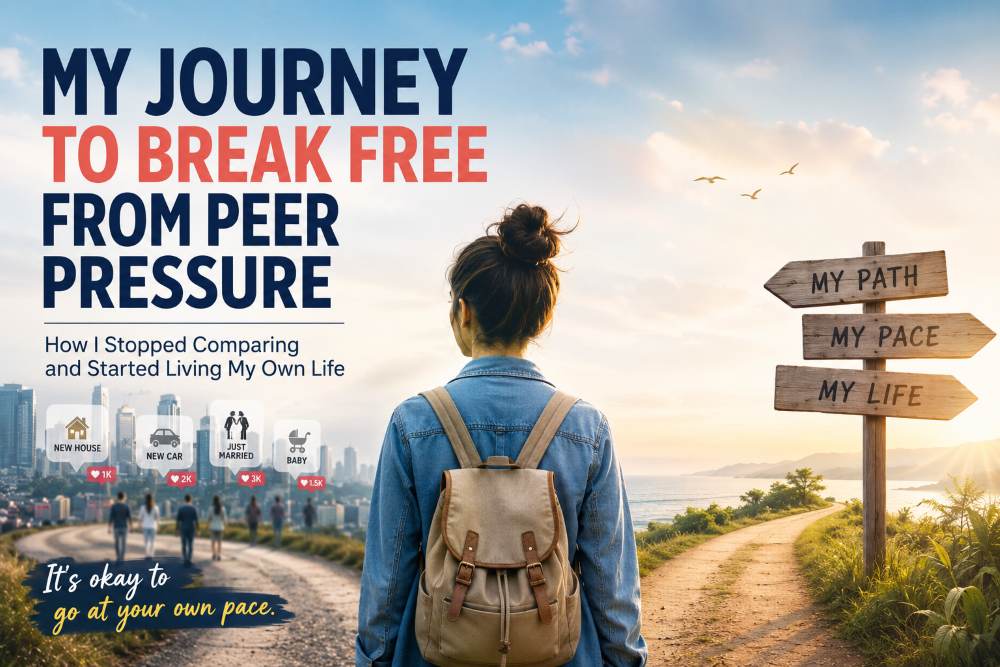
  • Escaping the Grip of Peer Pressure

    I remember a long period after my high school reunion when my heart felt heavy every time I scrolled through social media. The notifications for “bought a house,” “got a new car,” wedding photos, or baby announcements kept popping up like constant reminders of my own “lateness.” Some people were already settled down; others had climbed into management roles with big, ambitious plans. And then there was me—still standing there with a job that wasn’t exactly “stable” and savings that didn’t amount to much.

    Even though I kept telling myself that everyone has their own path, I couldn’t help but feel a pang of sadness. Looking at them and then back at myself, I felt like I was out of sync—playing a different note in a song where everyone else seemed to be perfectly on key.

    “Peer pressure doesn’t come from people forcing us; it comes from us using their ‘achievements’ as the yardstick for our own ‘worth’.”

    The comparison trap 

    That initial sadness slowly turned into poor decisions. I started forcing myself to run just to catch up. I dreamed of buying a house before my finances were solid; I wanted to settle for a random job just because people said, “at this age, you should be stable.” I even considered job-hopping—not because of passion or fit, but because a new title sounded more “on schedule” for my life.

    When I used someone else’s ruler, all my choices started going crooked. I was living for social validation instead of the actual needs of my heart.

    Every flower has its own season to bloom 

    After many exhausted days, a simple truth finally hit me: we never started from the same point. Some had family support, some got lucky breaks, and some found their passion early. As for me, I had spent a long stretch of the road just realizing I was trying to live someone else’s life.

    It turns out, life isn’t a race to a single finish line where everyone has to cross at the same time. Some people graduate at 22 but don’t find a job until 25; some become CEOs at 25 but pass away at 50. Each of us is living in our own time zone.

    “You aren’t late, and you aren’t early. You are right on time in your own time zone.”

    The fear of being left behind and the rushed footsteps 

    Deep down, what hurt the most wasn’t necessarily a lack of material things—it was the fear of being left behind. I was afraid of looking around one day to find my friends had all moved on to new stages, while I was still standing at the threshold, not confident enough to move forward but not brave enough to turn back.

    That fear is what pushed me—and perhaps pushes you, too—to live “faster than our capacity” instead of “true to our path.” We rush into marriage, rush into purchases, and rush into promotions just to feel like we still “belong” to the crowd. But in the end, we are the only ones who have to live with the consequences of those rushed choices.

    Learning to walk at your own pace 

    Escaping peer pressure isn’t about turning a blind eye to others’ success; it’s about stopping yourself from using that success to judge your own soul. I learned to ask myself more constructive questions:

    • Am I a little better today than I was yesterday?
    • Am I living truthfully according to my current abilities and circumstances?
    • Am I actually “slow,” or am I just choosing a different route? When I could answer those, the weight on my shoulders suddenly vanished.

    “The greatest success isn’t keeping up with others; it’s refusing to betray your own rhythm.”

    I’ve stopped forcing myself to be a successful carbon copy of someone else. I’m focusing on making the path beneath my own feet more solid—and if it takes a little longer, that’s perfectly fine. Because in the end, I’m not living to win the title of “First to the Finish Line”—I’m living to be myself, in the most whole and peaceful way possible.

    Peer pressure can feel like a thick fog that blurs your vision and hides your own path. Is there a milestone where you’ve felt “behind” your peers? How did you make peace with yourself in that moment? Let’s share our stories so we know that no one has to walk this journey alone.